

Over the past several months, we’ve had a lot of conversations with association professionals at conferences, events, and one-on-one meetings.
When the conversation turns to mentoring, member engagement, or leadership development, we often hear some version of the same responses:
These are understandable reactions. Association teams are busy. Budgets are tight. Staff are already managing events, education, advocacy, communications, governance, sponsorship, and dozens of other priorities.
If member numbers are stable and no one is actively complaining, doing something new can feel like creating work to solve a problem that doesn’t exist yet. But sometimes the biggest risk is not that something is obviously broken. It is assuming that because something is working today, it will continue to work the same way tomorrow.
That’s good. Healthy member satisfaction should be something to build on, not something to take for granted.
The challenge is that retention is a lagging indicator. It tells you who stayed. It doesn’t necessarily tell you how connected they feel, whether they see long-term value in the association, or whether they would recommend membership to someone entering the profession today.
A member may still renew, open emails, attend an event, or log into a platform without feeling particularly connected to the association. That makes the better question:
What are we doing today that will give members a reason to remain actively involved three, five, or ten years from now?
A structured mentoring program can be one of those reasons.
Mentoring gives members something highly personal that is difficult to reproduce through a newsletter, directory, or webinar: access to another person who understands their profession and is intentionally invested in helping them grow.
That creates a different kind of member value.
Across Pollinate’s association mentoring programs, when participants are asked whether the mentoring experience makes them want to become more involved with the association, approximately 70% indicate that it does. They want to see what else is available.
That is where mentoring becomes more than a professional development program.
It becomes a gateway into:
The goal is not simply to create a successful mentoring relationship. The strategic goal is to create a member who thinks:
“This association helped create something valuable for me. What else can I be part of?”
Through Pollinate’s partnership with the International Fresh Produce Association (IFPA), mentorship has become a pathway to deeper member engagement. In the Women’s Fresh Perspectives Mentoring Program, 70% of mentees reported that participating motivated them to become more involved in the association. Since 2021, the program has tripled in size, with more than 350 mentoring matches facilitated.
This demonstrates how structured mentorship can encourage members to build relationships and engage more deeply with their professional community.
Maybe. But there is another question worth asking:
Are younger professionals uninterested in association programs — or are they uninterested in programs that don’t feel personally relevant to them?
Someone entering a profession today may not need another email telling them there is a networking event next Thursday.
They may need help answering much more practical questions:
A directory doesn’t answer those questions, but a mentor potentially can. For newer professionals, mentoring can provide a landing pad within an industry or profession.
Instead of saying: “Welcome. Here’s our website and member directory.”
The association can say: “Welcome. We’re going to help you connect with someone who knows this industry and wants to help you succeed in it.”
Those are very different member experiences. And for industries facing labour shortages, aging demographics, or succession challenges, creating that sense of belonging matters.
A directory is useful. But a directory and a mentoring program solve very different problems. A directory tells a member who exists.
Mentoring helps determine:
Knowing someone’s email address does not automatically create permission, trust, purpose, or accountability. Associations already understand this distinction in other areas. We don’t hand someone the conference attendee list and call that networking. We design opportunities for people to connect. Career development deserves the same intentionality.
For more tips on mentor engagement click here
They absolutely do. Mentoring does not remove personal responsibility.
The mentee still needs to show up, set goals, ask questions, prepare for meetings, and act on what they learn. But associations have an opportunity to remove unnecessary friction.
There is an important difference between doing something for a member and creating the conditions that make it easier for the member to succeed.
Providing access to experienced professionals, making intentional introductions, and giving people a framework for those relationships does not take ownership away from members. It gives them a stronger starting point.
And when members succeed because of a relationship their association helped create, that success becomes part of the membership value proposition.
“We Have Enough Members. Acquisition Isn’t Our Priority.”
Maybe it doesn’t need to be your top priority today. But healthy membership pipelines don’t build themselves. Experienced members retire. People change careers. Industries evolve.
The professionals entering your sector today will eventually become your committee members, mentors, board members, speakers, sponsors, and industry leaders. Or they will build those relationships somewhere else.
Mentoring creates an opportunity to connect generations before knowledge disappears. Experienced members carry industry knowledge, leadership lessons, operational experience, mistakes, context, relationships, and judgement that can be difficult to capture in formal training.
Emerging professionals bring new perspectives, technology, expectations, and ways of working. Strong mentoring relationships allow those generations to learn from one another rather than drift further apart.
For associations concerned about succession, knowledge transfer, or future leadership, mentoring can become part of the infrastructure that keeps expertise inside the profession.
This may be the most legitimate objection of all. Association teams are already stretched.
A mentoring program that creates another spreadsheet, another inbox to monitor, another communication schedule, and another administrative workload probably isn’t going to make anyone’s life easier.
That is also why how a program is delivered matters. Working with Pollinate does not mean buying software and then being left to run everything yourself.
With Pollinate’s low-lift service model, a typical six-month mentoring pilot for approximately 50 participants can be designed and managed with as little as five hours of association staff time, depending on the scope and level of support required.
The goal isn’t to give your team another project. It’s to give your members another source of value without putting another program entirely on your plate.
Click here to learn more about what it’s like to work with us
Associations may not always identify mentorship as the solution they’re looking for.
Instead, members may be asking for:
These are all signals worth paying attention to. Mentoring isn’t necessarily the answer to every need. But structured mentoring relationships, peer learning circles, and group mentoring can help address many of these challenges because associations are uniquely positioned to facilitate connections that individual members may struggle to create themselves.
Some of the most valuable industry expertise already resides within the membership. The question is whether members can actually access it.
That leads to a more useful question: “Where are our members currently depending on luck to find the people, experience, and relationships they need?”
There are plenty of tools that can help you match two people. Pollinate’s approach is built around everything that needs to happen before and after that match to create a successful program.
The program is designed to minimize the burden on association staff while still giving the organization meaningful input into strategy, recruitment, and matching.
Pollinate supports API integrations that allow external systems to exchange data with the platform, reducing unnecessary manual work and duplicate data entry.
Backed by more than 20 years of research, Pollinate’s Knowledge Transfer Index (KTI) assesses seven elements of how people learn, communicate, and share knowledge, helping move mentor matching beyond job titles and years of experience.
Our Cross-Pollinate AI™ combines these insights with participants’ goals, experience, and client-specific matching criteria, while human review helps ensure recommended matches are thoughtful, relevant, and aligned with the program’s objectives.
Technology supports the program; it doesn’t replace the people required to make it successful.
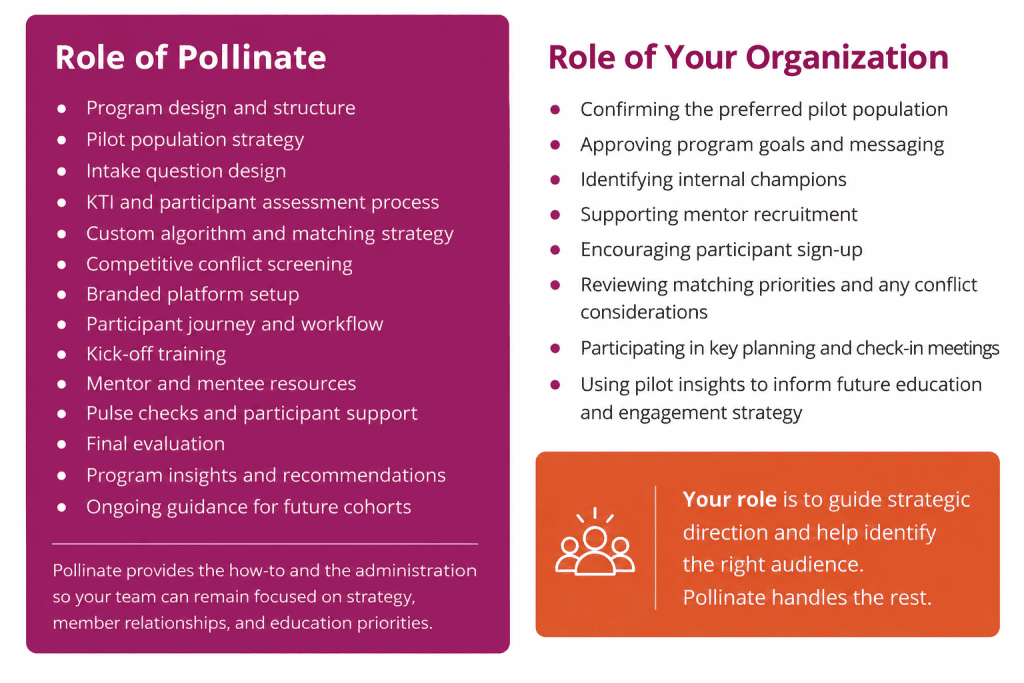
Pollinate’s team supports clients throughout program design, recruitment, matching, launch, engagement, troubleshooting, measurement, and reporting.
If your members are happy today, that’s a good thing. If your retention rate is healthy, that’s a good thing. If your membership base feels stable, that’s a good thing. But those are reasons to build from a position of strength, not reasons to assume tomorrow will look exactly like today.
It is easier to develop future leaders before experienced members retire. It is easier to engage younger professionals before the membership pipeline becomes a problem. It is easier to strengthen member relationships before people stop renewing. And it is easier to demonstrate relevance while members still feel connected to the association than it is to convince disengaged members to come back.
The familiar approach may still be working. But “it’s how we’ve always done it” isn’t a strategy for what comes next. The associations that continue to thrive will be the ones that keep asking:
What will make membership genuinely valuable to the next generation of people we need to attract, develop, and retain?
Mentoring is not the only answer.
But when it is structured intentionally, supported properly, and connected to an association’s broader goals, it can be a powerful part of that answer.
Don’t wait until members are looking for a reason to leave to start giving them another reason to stay.
Leave the heavy lifting to us!