
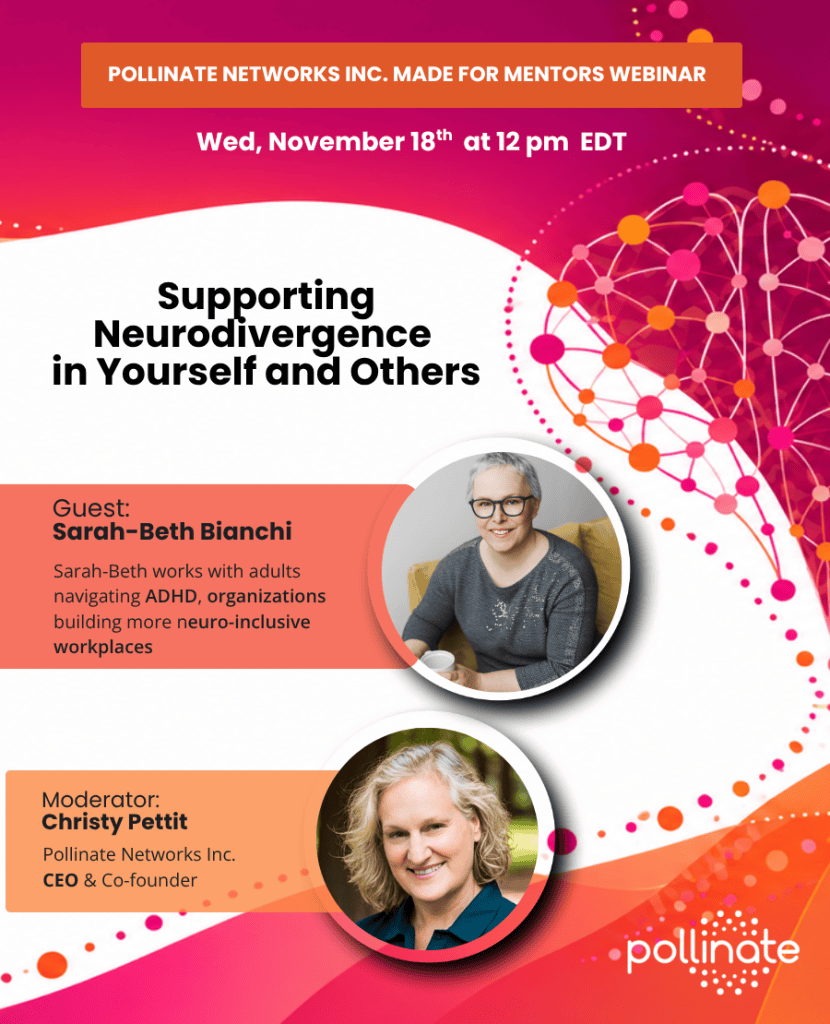
Every mentoring partnership is different because every person brings their own way of thinking, communicating, learning, and processing the world around them.
When neurodivergence is part of that partnership, whether you are a mentor, mentee, or both, greater awareness and understanding can help create a more supportive and meaningful experience.
Join Christy Pettit, CEO of Pollinate Networks, for a candid conversation with Sarah-Beth Bianchi, an ADHD coach whose professional expertise and lived experience with neurodivergence shape her approach to coaching, leadership, and building more neuro-inclusive environments.
Together, Christy and Sarah-Beth will explore what neurodivergence can look like within a mentoring relationship, how it may influence communication, expectations, goal setting, feedback, and connection, and what mentors and mentees can do to better support themselves and one another.
Rather than focusing on labels or assuming there is one “right” way to mentor, this conversation will look at practical ways to approach mentoring with greater curiosity, flexibility, and understanding. Whether you are neurodivergent yourself, mentoring someone who is, or simply want to become a more thoughtful and adaptable mentor, you’ll leave with ideas you can bring into your own mentoring relationships.
Sarah-Beth Bianchi (she/her) is an ADHD coach whose lived experience with neurodivergence shapes the heart of her practice. She works with organizations building more neuro-inclusive workplaces, adults navigating ADHD in work and life, and parents and caregivers seeking approaches that fit their family dynamics. She is skilled at listening deeply, reflecting clearly, and asking questions that unlock new insight without pressure or judgment.
Sarah-Beth brings 20 years of experience in tech, leadership, and coaching. She trained as a coach through Concordia University, holds her ACC credential with the International Coaching Federation, and is completing ADHD-specific certification through MentorCoach and PAAC. Based in Kitchener, Ontario, she is committed to coaching that is evidence-based, grounded in equity, and informed by lived experience with neurodivergence.