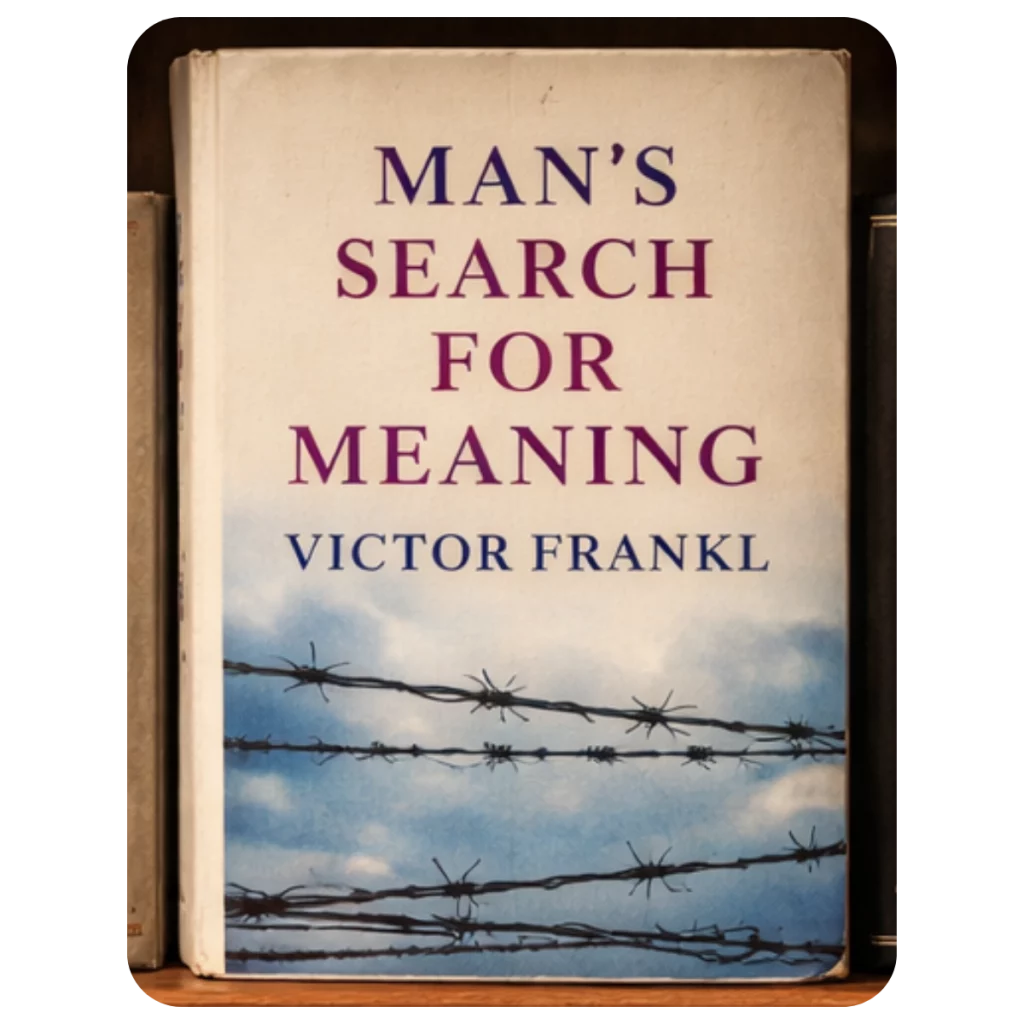

When mentors are asked which book they return to again and again, Viktor Frankl’s Man’s Search for Meaning consistently rises to the top.
It is not recommended because it is comfortable. It is recommended because it is clarifying. It confronts suffering directly, explores the psychology of survival, and offers a framework for living with purpose that applies far beyond the extreme conditions in which it was formed.
Frankl’s insights were forged in Auschwitz. In his account of life in the concentration camps, he describes three psychological stages prisoners experienced: the initial shock upon arrival, the apathy that gradually numbed daily camp life, and the complex emotional challenge of reintegration after liberation. Mentors often point to this progression because it mirrors, in less extreme ways, how people respond to crisis, burnout, and transition. Shock. Numbness. Then the difficult work of rebuilding.
Frankl observed that hopelessness led many prisoners to contemplate suicide, some choosing to run toward the electric fence. He himself made a private commitment not to “run into the wire.” That decision, small but powerful, reflected the core idea mentors want others to understand: even in unimaginable circumstances, there remains a choice. There remains a response.
At the heart of the book is the idea captured in Nietzsche’s line, “He who has a why to live can bear almost any how.” Frankl saw that prisoners who held onto meaning, whether it was love for family waiting at home or unfinished work they felt responsible to complete, were more likely to preserve their inner lives. He recounts men who selflessly took the place of others who had more to lose. In a place where individuals were stripped of their names and reduced to numbers, where one literally became a number, purpose became an anchor.
Mentors recommend this book because it reframes resilience. Endurance is not simply grit. It is meaning-driven.
Frankl’s psychological framework, Logotherapy, grew out of these experiences, though he had begun developing it before the war. He described it as the Third Viennese School of Psychotherapy, alongside Freud’s psychoanalysis and Adler’s individual psychology. Where Freud emphasized the will to pleasure and Adler the will to power, Frankl emphasized the will to meaning. He believed that the primary human drive is not pleasure or dominance, but the search for purpose.
This is especially relevant in modern professional life. Frankl described what he called the existential vacuum, a pervasive sense of emptiness that emerged after the war but remains recognizable today. When meaning is absent, people often turn to pleasure, power, wealth, recognition, or distraction. These may temporarily fill the void, but they do not resolve it. Mentors see this frequently in high achievers who reach success yet still feel restless or unfulfilled. The book gives language to that experience and offers a different path.
For Frankl, meaning could be found in three primary ways: through love, through creative or meaningful work, and through the attitude one adopts toward unavoidable suffering. He wrote that love is the ultimate and highest goal to which a person can aspire. While laboring in brutal conditions, he sustained himself by imagining conversations with his wife, unsure if she was even alive. That inward connection gave him strength. Mentors often recommend this book because it restores depth to conversations about ambition. Work matters. Achievement matters. But love and responsibility give them context.
Frankl also challenged prevailing assumptions in psychology. He argued that questioning the meaning of one’s life is not necessarily a sign of mental illness but can reflect an inner tension that is healthy and necessary. He called for a more humane psychiatry, one that recognized dignity even for those with severe or incurable mental illness. He believed that individuals should be judged for more than their conditions or circumstances. That stance resonates strongly in mentoring relationships built on respect and belief in human potential.
Another powerful insight from the book is Frankl’s observation that humanity divides not into categories of prisoner and guard, but into what he called the race of the decent and the race of the indecent. He witnessed cruelty, but he also witnessed compassion, including rare acts of kindness from unlikely sources. This conclusion reinforces a central mentoring lesson: character is a choice, not a role.
Perhaps the most enduring message mentors draw from Man’s Search for Meaning is the concept of inner freedom. Frankl insisted that even when everything is taken from a person, one freedom remains: the freedom to choose one’s attitude. This is not abstract philosophy. It is a principle of leadership. Circumstances may constrain you, but they do not have to define you.
Frankl went further, suggesting that life holds an unconditional meaning that may not always be fully articulated. “Logos,” the Greek word for meaning, he argued, runs deeper than logic. He believed that even the transitory nature of life does not strip it of value. “Having been is the surest kind of being.” The past cannot be erased. What we have lived, endured, and chosen becomes part of our permanent reality. This perspective reframes aging, loss, and regret in a way that many mentors find deeply helpful for those navigating life transitions.
Man’s Search for Meaning endures because it speaks across generations. It addresses suffering without sentimentality. It challenges nihilism without preaching. It insists on responsibility without denying hardship.
Mentors recommend this book not because it offers quick answers, but because it anchors people in something deeper. It builds resilience rooted in purpose. It restores agency in the face of constraint. It names the emptiness that success alone cannot fill. And it reminds us that at some point in every life and every career, finding your why is not optional.
It is essential.
Written by Cade Meloche, individual contributor to Pollinate Networks Inc.