What is the Knowledge Transfer Index?
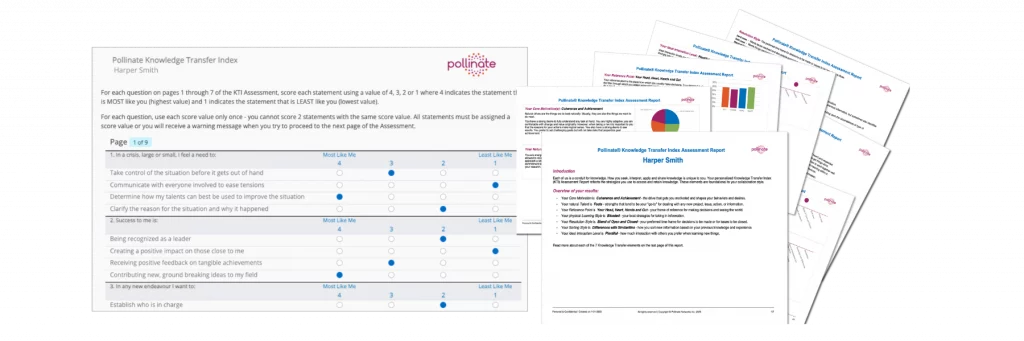
Pollinate’s Knowledge Transfer Index (KTI) is a validated psychometric assessment designed to improve collaboration, mentoring, and learning outcomes. It evaluates seven dimensions of how people prefer to work, learn, and communicate, giving your program the insight it needs to create successful matches and guide more meaningful conversations.
How do I answer the KTI?
For each question on pages 1 through 7 of the KTI Assessment, score each statement using a value of 4, 3, 2 or 1 where 4 indicates the statement that is MOST like you (highest value) and 1 indicates the statement that is LEAST like you (lowest value).
For each question, use each score value only once – you cannot score 2 statements with the same score value. All statements must be assigned a score value, or you will receive a warning message when you try to proceed to the next page of the Assessment.
Can I change my answers after I have submitted the KTI?
Yes, by emailing measurement@pollinate.net, we can resend you your unique KTI link to reopen. You will see your previously provided answers. You can then change them as needed and resubmit your responses. This will generate a new report that will be sent to you with your updated responses.
I can’t find my report, or I have not received my report.
Your KTI Report will be sent to you as a PDF attachment in an email from mentoring@pollinate.net. If you cannot locate this email, please check your spam/junk folder. If you are still unable to locate it, please email measurement@pollinate.net and we will be happy to share it with you.
How are you going to use this data?
We use the result of your KTI when matching mentoring pairs. Pollinate has assessed thousands of pairs and hundreds of small groups to develop the Knowledge Transfer Index, based on 7 elements of style, preference and ability that affect how people work and learn together.